
Elford’s Traffic Study at Boundless: Inadequate Scope, Unacceptable Standards
Summary:
The Elford traffic study with appendices can be found here https://www.worthington.org/DocumentCenter/View/13306/Boundless-TIS-Full-Report-W-Appendices-6-17-2026?bidId=, or in summary form in the MPC agenda packet, on pages 147-153 ; https://worthington.org/ArchiveCenter/ViewFile/Item/6737
The traffic study submitted by Elford is exceedingly narrow in scope—focusing on a single traffic light at Proprietors Rd. and Dublin Granville Rd. (SR-161) and a roundabout internal to the proposed apartment complex. The study gives no consideration to traffic impacts on the wider Dublin Granville corridor, adjoining streets and intersections, Colonial Hills, and the community as a whole.
Further, the study considers Level of Service grades of D and E (on an A-F scale) as acceptable in Worthington, when in fact they are highly undesirable and to be avoided.
Yet those promoting the project—Elford, Building Worthington’s Future (BWF), and the City itself—are attempting to gloss over these essential shortcomings, and are inappropriately citing the study as if it validates their broad claims that the traffic impact on our community of the Elford apartment complex would be “negligible.”
In fact, the study does not address, nor support, these claims.
The current study may be adequate in answering questions that Elford has about localized traffic-related problems for future tenants. This would explain the study’s focus on the single traffic light and the internal roundabout.
But the study does not even attempt to address the questions of real concern to the wider Worthington community, such as safety, congestion, diversions and cut-throughs along adjacent streets, transit times, noise, and pollution. Not to mention the inevitable pressure to open a second access point into and out of Colonial Hills.
Our city government “collaborated” with Elford on this study, and now recommends approval of the project as a whole, justified in part on the claimed adequacy of the traffic study. Why? And who decided this?
I expect a developer, at least most of them, to try and squeeze as much as possible from a project. And that is exactly why we need, and reasonably expect, our government officials to question, scrutinize, challenge, and require from developers an adherence to high standards in the service of the public interest. That is their job.
I do not see how anyone could make the argument that our city government has in fact done so regarding the submitted traffic impact study for the proposed Elford project.
Further study, asking the real and right questions in the public interest, is needed.
_________
So that you may judge for yourself the interpretation and meaning of the study, what follows is a description of the study’s physical context, and a bare outline of the study’s scope, data sources, assumptions, and performance standards. Also, Parking will be briefly discussed, of particular relevance to Colonial Hills.
Physical Context:
Elford is proposing to build the largest apartment complex in the history of Worthington (246 units, 1/2/3 bedroom), on a piece of land abutting railroad tracks to the east, Colonial Hills to the south, the Boundless facilities and Rush Creek to the west, and Dublin Granville Rd to the north.
All traffic going into and out of the apartment complex would have to use a single two lane road (pictured below) that would be regulated by a single traffic light at the intersection of Dublin Granville and Proprietors Rd.
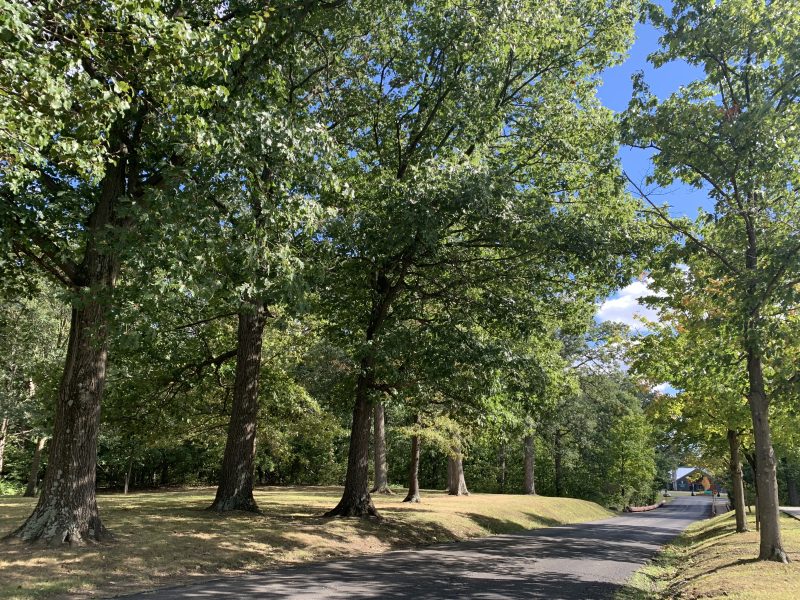
Proprietors, heading north from the traffic light, is a two lane road, commercial on the east, mostly residential on the west.
Dublin Granville is also a two lane road, but with a middle turn lane.
Heading east, toward I-71, it first proceeds under a railroad bridge.
Heading west (pictured at top) it runs through residential areas, passing East Granville Park, Kilbourne Middle School, the Historic District and our Village Green, more residential, Thomas Worthington High School, and, after crossing the Olentangy River, route 315.
Study’s Scope:
The scope of the study was developed “in coordination with the City of Worthington.” Only three elements were selected for study. The signalized intersection at Dublin Granville and Proprietors, an internal roundabout, and pedestrian connectivity with surrounding neighborhoods.
Data Sources:
Traffic counts were conducted during just one 12 hour period, the week before Christmas, on December 17, 2025. Is this an adequate sampling, a fair representation of general traffic flows?
Assumption:
Projections of site-generated traffic were “assigned based on existing traffic patterns.” Unless I’m missing something, this seems like backwards logic. The apartment complex traffic would largely flow out in the morning and back in the late afternoon. The existing Boundless traffic is largely the opposite, is it not?
Levels of Service:
In the world of traffic engineering there is a grading system, A-F, used to describe “Level of Service.” It was decided by someone—a collaboration between the City and the consultants?—that Level of Service grades of D and E were acceptable.
“During the AM and PM peak hours, a Level of Service (LOS) D or better was used as the acceptable threshold for overall intersection operations, with LOS E considered acceptable for individual movements.” (p.2 of traffic study)
LOS D: Density increases faster, and speed begins to decline. There is limited ability for drivers to maneuver, and drivers experience reduced comfort. Traffic is unable to absorb disruptions, and minor incidents will cause queueing.
LOS E: Traffic is operating at near capacity, and there is little to no room for drivers to maneuver between lanes. Any changes, such as merging vehicles, will cause upstream disruption. There is very little driver comfort, and any incident will cause a traffic breakdown and major queues.
LOS F: At this level, there is breakdown of traffic and unstable flow resulting from a bottleneck at a downstream point. This occurs when the ratio of demand to capacity exceeds 1.00. This can occur for reasons such as traffic incidents reducing capacity and points of congestion where more vehicles are entering than exiting.
Descriptions of all LOS grades can be found here: https://www.smatstraffic.com/blog/level-of-service
The study concludes that AM traffic will meet the “acceptable” standards of D and E. However, “During the PM peak hour, the intersection operates at LOS E under existing signal timing for both the Opening Year and Horizon Year, with and without site traffic. This does not meet the established LOS criteria. The eastbound and westbound through movements also operate at LOS F during the PM peak hour, Horizon Year, Build and No Build. Unacceptable LOS values are highlighted in red in Table 1.”
The proposed action to mitigate these substantial problems? Optimize the signal timing using Highway Capacity Software (HCS).
And thus the study concludes: “It is clear … that the addition of development traffic has an almost negligible impact on delays for any intersection movement or the full intersection.” The adequacy of this I leave to your judgment.
Also, Parking:
Worthington’s general Code (1171.01) requires two off-street parking spaces per apartment. On this basis, Elford’s 246 units would require 492 parking spaces. However, the City is planning to create a Planned Unit Development (PUD) to rezone the Elford project.
To put it generously, the PUD allows great flexibility for developers and the City. The City justifies this blank-slate zoning on the basis of enabling control of details for complex projects. To not be abused, a PUD needs responsible leadership and prudent judgment.
The PUD requirements stipulate “at least 1 parking space per dwelling unit.” This minimalist requirement might make sense if an apartment complex was located near adequate public transportation lines (bus or light rail). That is not the case at Elford.
As it is, Elford is proposing just 325 parking spaces (while this is 32% more than is strictly required by terms of the PUD, it is 34% less than the standard requirement of 492 spaces).
Question: If the 246 apartments, 1/2/3 bedrooms, result in more than 325 cars, where will they park? My guess is along the nearest adjacent streets in Colonial Hills. If you do the math, the numbers and impact are significant and daunting for that neighborhood.
Conclusion:
As stated above, further study of traffic impacts, asking the real and right questions in the public interest, is needed before approval of the Elford project could be responsibly and credibly granted by our city government.

You must be logged in to post a comment.